What to Grow with Eggplant | And What Not to Grow with It
Eggplant – aubergine in British English, the same plant by any name – faces a pest that most other crops in this guide series don’t: flea beetle. These small, shiny, jumping beetles arrive in spring before most protective measures are in place and create clusters of small round holes in young eggplant leaves.
A severe infestation in April or May can set a plant back significantly before the growing season has properly begun. Companion planting addresses flea beetles most effectively as a preventive measure. By positioning aromatic deterrents and trap crops in place before the beetles arrive, not after the damage has started.
Eggplant also shares the heat requirements of peppers and okra, which shapes the companion cluster in the same way. Position in the warmest, most sheltered corner of the rooftop or balcony, cluster with other heat-loving crops to concentrate warmth, and build the pest management companions around the outside of that cluster.
Basil, which earns its place beside tomatoes and peppers for the same reasons, is equally well-suited here.
Flea beetle the companion planting priority for eggplant
Flea beetle is the pest that most consistently damages eggplant in a container growing setting, and it operates on a specific seasonal timeline. Adult beetles overwinter in soil and plant debris and emerge in April, coinciding almost exactly with when eggplant transplants go outside.
They target young eggplant foliage immediately, chewing small round holes through the leaf surface and jumping when disturbed – which is both how they’re identified and how they avoid being caught.
Heavy flea beetle damage in May and June reduces the plant’s photosynthetic capacity and slows growth during the critical establishment period. Plants that lose significant leaf area early in the season take longer to reach fruiting stage and produce fewer fruits overall. This makes early-season companion positioning – before the beetles emerge – more valuable than any intervention after damage has appeared.
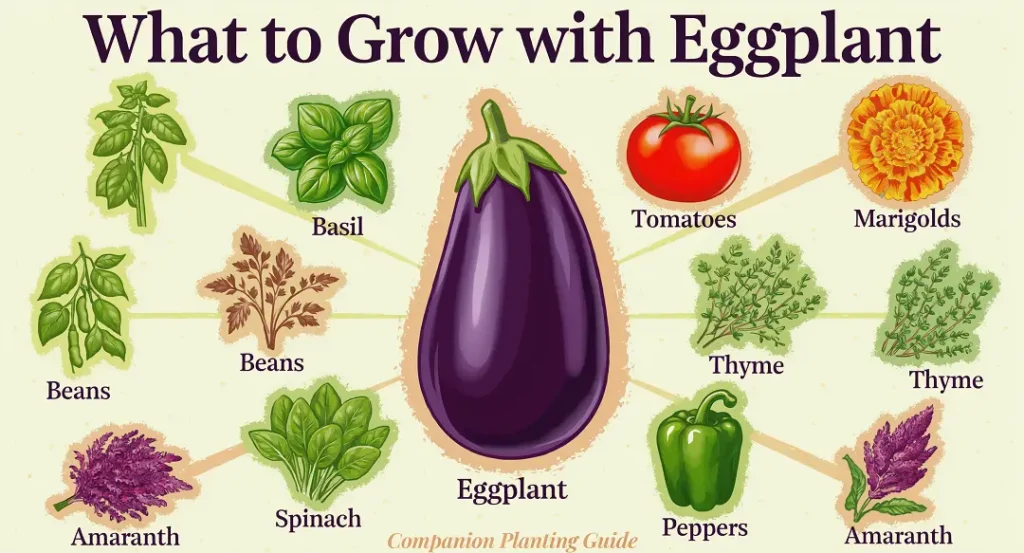
What to Grow with Eggplant
The companion approaches that address flea beetle are aromatic deterrence, which interferes with the beetle’s ability to locate host plants, and trap cropping, which draws beetles to a more attractive alternative. Both work better as setup-before-the-season measures than as reactive treatments.
Companions that deter flea beetle from eggplant
The four companions below each address flea beetle through different mechanisms. Basil and tarragon work through aromatic disruption of the beetle’s host-finding. Thyme adds a ground-level aromatic layer.
Nasturtium provides the trap crop function. Position all four before the eggplant transplants go outside, which means setting up the companion cluster in April, when flea beetles emerge, even if the eggplant itself goes out in May.
Basil
Basil is the companion most naturally suited to eggplant for the same reasons it suits tomatoes and peppers: identical growing requirements and volatile oil production that deters the pests these crops share.
Flea beetle, aphids, and whitefly all show reduced activity around actively growing basil through the deterrent effect of its aromatic oils. The flea beetle deterrence is more observational than documented, but the aphid deterrence has broader support, and the two effects together make basil the first companion to place beside eggplant.
A 3 to 5 litre pot of basil placed directly beside the eggplant container – in the sunniest, warmest available position – provides aromatic deterrence through the season while yielding a kitchen harvest.
Keep it harvested and pinched back regularly: active, bushy basil produces more volatile oil than a plant that has flowered and slowed. This is the same principle that applies beside tomatoes and peppers, and the same management that makes the companion effective rather than merely present.
Full growing guide: How to grow basil in containers
Tarragon
Tarragon is the companion most specifically associated with eggplant in traditional companion planting literature, and flea beetle deterrence is the consistently stated reason for the pairing.
French tarragon – Artemisia dracunculus sativa – has a more intensely aromatic profile than Russian tarragon and is the variety that provides the companion effect. Russian tarragon, which is more commonly available from seed, has a weaker flavour and weaker aromatic output – worth noting when sourcing plants.
The evidence for tarragon’s flea beetle deterrence is traditional and observational. The mechanism – aromatic disruption of the beetle’s navigation to host plants – is the same as for basil and thyme, but the specific association with eggplant appears consistently enough across growing accounts to treat this as the classic eggplant companion.
Grow French tarragon in its own 15cm pot placed beside the eggplant container. It’s a perennial that returns each year, making it a long-term fixture in the eggplant companion cluster.
Thyme
Thyme provides aromatic flea beetle deterrence at ground level, adding a lower-intensity contribution to the companion cluster that covers a different height zone from the basil and tarragon beside it. Flea beetles are low-flying when they move between host plants, which makes ground-level aromatic presence relevant.
Thyme’s drought tolerance means it needs its own pot with independent watering – eggplant requires consistent moisture through its fruiting period, while thyme prefers to dry out between waterings. A small adjacent pot with its own drainage and water schedule is the right arrangement.
Thyme is perennial and will return each year in the eggplant companion cluster with no replanting. Prune it back after flowering to keep it compact and producing the aromatic new growth that delivers the companion effect.
Nasturtium
Nasturtium’s trap crop function beside eggplant covers two pests: aphids, where the evidence is strongest, and flea beetle, where the evidence is more observational but the mechanism – the beetle preferring nasturtium foliage as a host – is plausible given nasturtium’s broad attractiveness to many garden pests.
As a trap crop, nasturtium concentrates the pest population on a companion that can be monitored and managed rather than allowing it to build on the eggplant itself.
The monitoring requirement is the same here as in every other trap crop context: a small pest population on the nasturtium is the system working. An overwhelmed nasturtium with extensive flea beetle damage or a heavy aphid infestation must be removed before the population migrates.
Check every three to four days through April, May, and June when both flea beetle and early aphid pressure are at their highest.
Companions that attract pollinators and manage aphids
Beyond flea beetle, eggplant faces aphid pressure through spring and summer and benefits from pollinator attraction for reliable fruit set.
Eggplant is self-pollinating but produces more prolifically with regular pollinator visits – the same dynamic as okra, where the companion’s primary role is bringing bees into the growing area rather than providing pest deterrence. The two companions below address both functions.
Marigold
French marigold beside the eggplant container provides nematode suppression in the surrounding compost and hoverfly attraction through its flowers. Hoverfly larvae predate aphids at a rate that meaningfully reduces aphid pressure in the cluster – adding a biological control layer alongside the aromatic deterrence from basil and tarragon.
In a container system where eggplant pots are reused across seasons, nematode build-up is a gradual concern, and marigold’s root secretions address it passively throughout the season.
One or two marigold plants in 10 to 15cm pots placed at the base of the eggplant container are sufficient. Keep them deadheaded through the season to maintain continuous flowering – the hoverfly attraction is tied to the flowers, while the nematode suppression operates through the roots regardless.
Borage
Borage beside eggplant provides strong pollinator attraction through its continuous succession of blue flowers. Eggplant flowers are visited by bees in the same morning-activity window as other solanaceous crops – having borage in flower beside the container during the fruiting period increases the frequency of those visits and the overall fruit set.
The secondary claim – that borage deters tomato hornworm, which occasionally affects eggplant – is observational rather than documented, but borage earns its position through pollinator attraction alone.
Grow borage in its own 15 to 20 litre pot placed beside the eggplant container. Manage self-seeding by removing spent flower heads before seed sets if you’re working in a confined container space.
Compatible neighbours for eggplant
Two plants coexist productively alongside eggplant without providing the specific companion benefits of the pest management group above. Both are worth noting as safe and practical neighbours in a container growing setup where eggplant, peppers, and heat-loving crops share the same rooftop corner.
Peppers
Peppers and eggplant are natural cluster companions on a rooftop or balcony because their requirements are almost identical: 6 to 8 hours of direct sun, sustained warmth, protection from cold nights, and consistent moisture through the fruiting period.
Clustering pepper containers with eggplant in the warmest available position concentrates heat for both crops simultaneously – the same principle as the okra and pepper heat clustering covered earlier in this series.
What peppers don’t do is deter eggplant pests or provide active companion benefit in the pest management sense. The relationship is compatible coexistence: the crops grow well together, the heat microclimate clustering benefits both, and positioning a pot of basil between the eggplant and pepper containers means that basil’s volatile oil deterrence benefits both crops simultaneously.
Full companion context: What to grow with peppers
Spinach
Spinach in a shallow trough beside the eggplant container makes productive use of the early spring window before the eggplant is fully established and before flea beetle pressure peaks. Spinach goes in early spring; eggplant transplants go outside in May or later, depending on temperatures.
The two crops occupy the space in complementary rather than competing stages – spinach producing through April and into May, the eggplant establishing as the spinach finishes.
By the time the eggplant reaches full size and the flea beetle season begins in earnest, the spinach is cleared and the space it occupied can hold a companion pot – nasturtium or marigold – that serves the eggplant through the summer season.
What not to grow with eggplant
Three plants belong away from eggplant containers, each for a specific reason.
Fennel
Fennel is allelopathic to eggplant as it is to most vegetables. Keep it isolated from the main growing area entirely – at the opposite end of the rooftop from the heat cluster where eggplant, peppers, and basil are positioned.
Corn
Corn attracts corn earworm – a pest that also targets eggplant foliage and developing fruit. Growing corn and eggplant in close proximity concentrates earworm pressure on both crops simultaneously in a way that makes both harder to manage. In a small rooftop or balcony space where physical separation is limited, keeping these two crops in different areas reduces the combined target.
Brassicas
Brassicas are worth keeping away from eggplant for two reasons. Brassica root compounds are reported to interfere with the growth of solanaceous crops including eggplant, and the pest management approaches for the two crop families are different enough that clustering them together creates competing companion systems that interfere with each other.
The kale companion system built around aromatic herbs that mask glucosinolates is working at cross-purposes with the eggplant companion system built around aromatic herbs that mask solanaceous volatile compounds. Keep each crop family in its own dedicated cluster.
A note on solanaceous disease management: tomatoes, peppers, and potatoes share disease susceptibility with eggplant – verticillium wilt and phytophthora affect all solanaceous crops.
This is not a reason to avoid growing them on the same rooftop, but it is a reason to maintain some physical separation between them and to avoid reusing compost between solanaceous containers without replacing it fully between seasons.
A few final words
Eggplant companion planting is a flea-beetle-first, heat-cluster system. Position tarragon, basil, and thyme in the eggplant cluster before April, when flea beetles emerge. Add nasturtium as a trap crop in a railing planter where it’s accessible for monitoring. Place marigold at the container base for nematode suppression and hoverfly attraction, and borage nearby for pollinator draw through the fruiting period.
That cluster – set up at the start of the season and managed through active trap crop monitoring – addresses flea beetle, aphids, nematodes, and pollination in one arrangement.
For the full basil growing detail that sits at the centre of the cluster, the basil container guide covers the season completely. And for the pepper companion system that clusters naturally beside this one, the guide to growing with peppers covers the full heat cluster arrangement.